
A Power of Attorney for property owners in BC isn’t a “someday” document — did you know your spouse, adult child, or family member has no automatic legal authority to deal with your property if something happens to you? If you own land, here’s why you need one as soon as you own that property.
TL;DR
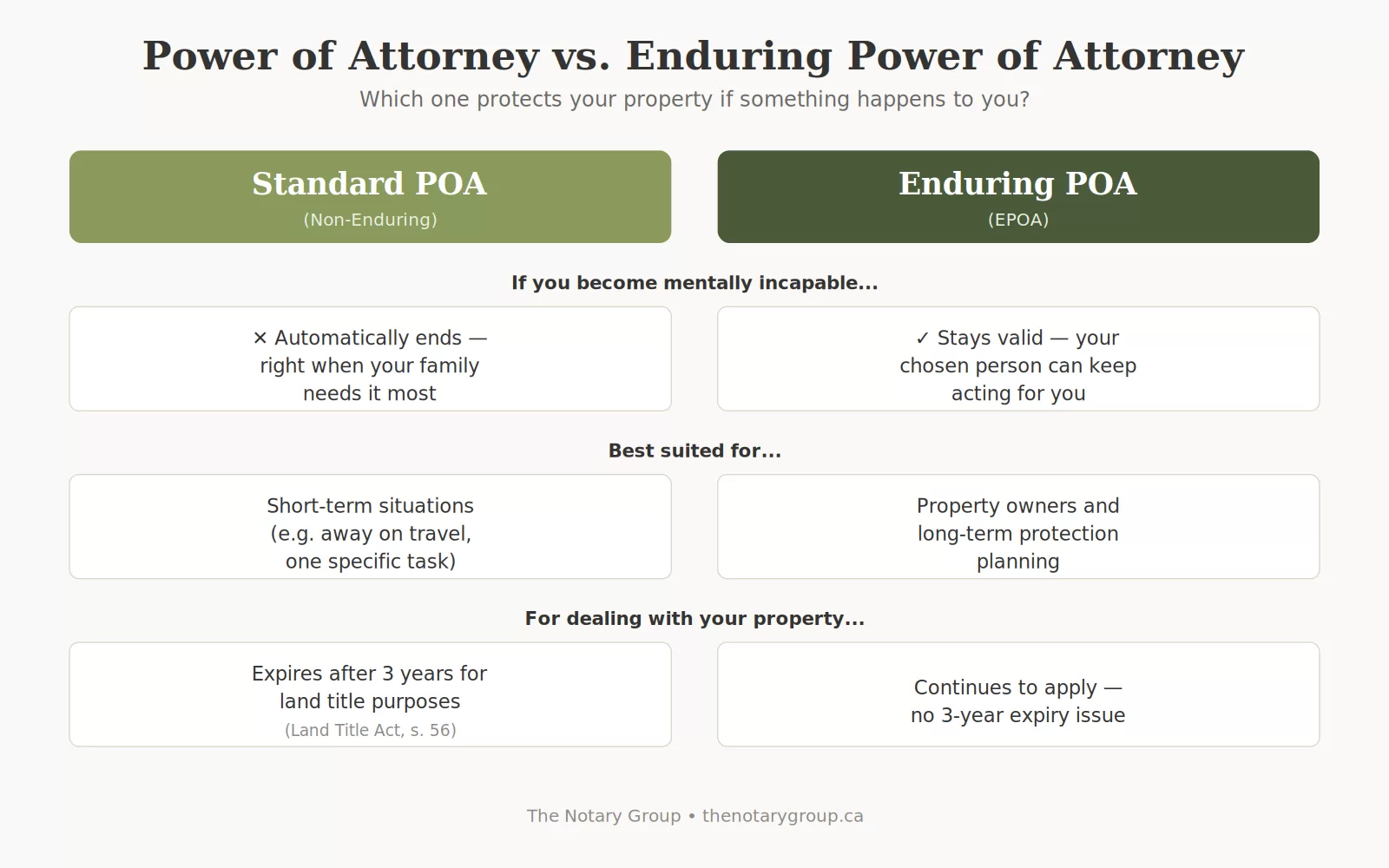
Even if you’re married, even if you bought the property together, even if both your names are on title — your family members cannot automatically sign documents, sell, refinance, or deal with your share of a property on your behalf if you become unable to do it yourself. Property registration systems in BC require a validly signed Power of Attorney naming exactly who you trust to step in. For property owners, that document should almost always be an Enduring Power of Attorney — one that stays valid even if you later become mentally incapable. A standard (non-enduring) POA expires after 3 years for land title purposes under s. 56 of the Land Title Act, often right when your family needs it most.
Your spouse can’t automatically sign for you
The assumption that trips people up is this: “If something happens to me, my spouse/parent/child can just deal with the house.”
They can’t. Not automatically. Even if you’re married, even if you bought the property together, even if both your names are on title — your family members have no automatic legal authority to sign documents, sell, refinance, or deal with your share of the property on your behalf if you become unable to do it yourself.
Property registration systems don’t take your relationship on faith. They want a validly signed POA telling them exactly who YOU trust to step in to help you if you can’t do the work yourself.
Watch: If you own property, get a POA
Why land ownership raises the stakes
A POA matters for lots of reasons — bank accounts, bills, general financial affairs. But property ownership adds a layer most people don’t think about until they’re in the middle of a transaction:
- Real estate deals move fast, and they don’t wait for a court date to resolve. If you’re mid-sale, mid-refinance, or need to deal with your property while incapacitated, there’s no “we’ll figure it out later.” Without a valid POA, your family is left applying to court — sometimes for full committeeship, sometimes for a narrower order dealing with just that one transaction — but either way, that’s weeks or months of delay, legal costs, and uncertainty sitting on top of an already difficult time.
- Property registration systems each have their own strict rules. A POA that would be perfectly fine for, say, managing your bank account can still get rejected for land title purposes if it doesn’t meet specific signing and registration requirements.
- Standard (non-enduring) POAs expire — often exactly when you need them. Under section 56 of BC’s Land Title Act, a non-enduring Power of Attorney isn’t valid for land title purposes more than three years after it was signed, unless the document specifically excludes this rule. If you made a standard POA more than three years ago, it may no longer be usable for anything involving your property, even if you still have the original in a drawer somewhere.
- Name mismatches can derail everything. If the name on your POA doesn’t exactly match the name on title, property registration systems like the Land Title Office can refuse to register the document.
The document you actually want: an Enduring Power of Attorney
For property owners, what you almost always want is an Enduring Power of Attorney: a document that stays valid even if you later become mentally incapable.
Ordinary (non-enduring) POAs are meant for short-term situations and automatically end the moment you can’t give instructions yourself, which is exactly the moment your family is likely to need one most.
A quick, real scenario: imagine a couple in their 50s, both healthy. They decide to name each other as attorneys “just in case” — one has a family history of stroke, the other of cancer. They set up Enduring Powers of Attorney appointing each other, and name their adult kids as backups. Nothing dramatic happens for years. Then something does. Because the paperwork was already in place, dealing with the house wasn’t a crisis on top of a crisis.
What this actually protects
A properly made, properly signed, up-to-date Power of Attorney for property owners means:
- Your chosen person can act on your behalf without a costly, stressful court application: without a POA, your family might have to get a court order called a “committeeship”, or a narrower, specific court order to deal with your property. This results in months of delay, court applications and thousands of dollars in costs.
- Real estate transactions don’t get stuck mid-deal if something happens to you. You don’t get sued because you weren’t able to carry through on a deal.
- You control who gets this authority. The other option is the court decides who deals with your affairs.
- You avoid the common, preventable pitfalls (expired documents, name mismatches, missing Land Title Act language) that cause POAs to fail exactly when they’re needed.
FAQs – Power of Attorney and property ownership in BC
Does my spouse automatically get to deal with our property if I become incapable?
No. Even joint owners and spouses have no automatic authority to sign, sell, or refinance on your behalf without a valid Power of Attorney.
How long is a standard Power of Attorney valid for dealing with land?
Under s. 56 of the Land Title Act, a non-enduring POA is generally only valid for land title purposes for 3 years from the date it was signed.
What’s the difference between a POA and an Enduring Power of Attorney?
A standard POA automatically ends if you become mentally incapable. An Enduring Power of Attorney is specifically designed to continue in effect if that happens — which is exactly when your family is most likely to need it.
What happens if I don’t have a Power of Attorney and become incapable?
Your family may need to apply to court for a committeeship, or a narrower court order dealing with a specific transaction — both of which involve delay, cost, and uncertainty that a properly made POA avoids.
Final note
This is general information only and isn’t legal advice. If you own property — a home, a rental, a vacation property, anything registered in your name — a Power of Attorney isn’t a “someday” document. It’s part of protecting the asset itself, the same way insurance is.
Need help? Contact us. A Power of Attorney for property owners is one of the simplest ways to protect what you’ve built. If you don’t have one, or you’re not sure whether the one you made years ago still holds up, get in touch with our team — we’re happy to help.