
TL;DR: A covenant is a formal, written promise registered against a property’s title in BC that either requires the owner to do something, or prohibits them from doing something, on the land.
In plain language: A covenant is a formal, written promise registered against a property’s title in BC that either requires the owner to do something, or prohibits them from doing something, with the land. Not all covenants automatically bind future owners — whether a covenant “runs with the land” depends on how the instrument is drafted and whether specific legal requirements are met.
What is a covenant on title in BC?
A covenant is a formal, written promise registered against a property’s title that either requires the owner to do something or prohibits the owner from doing something with the land. Covenants appear as charges on a BC Land Title search, alongside mortgages, easements, rights of way, and other registered interests — and they can have a real effect on what an owner is allowed to do with the property, sometimes for decades or generations.
Does a covenant on title bind every future owner?
Not automatically — and this is one of the most misunderstood points about covenants. Registering a covenant against title is necessary, but it is not, by itself, sufficient to bind every future owner.
For a private covenant to “run with the land” — meaning it binds successors who never signed the original agreement — the instrument creating it must satisfy several legal requirements:
- the obligation must be genuinely negative or restrictive in substance, not a disguised positive obligation
- it must “touch and concern” the land — affecting its use, nature, or value — rather than being a purely personal arrangement between the original parties
- both the burdened land and the benefitted land must be clearly identified in the instrument
- the intent to bind successors must be apparent from the document as a whole
Courts in BC have struck down covenants that failed these tests, even where the wording looked restrictive on its face. The BC Court of Appeal has held that simply affecting how land may be used is not, by itself, enough to make a covenant run with the land — and that “successors and assigns” language, while common, is not on its own determinative. Because of this, courts interpret restrictions on land use strictly, and any genuine ambiguity is resolved in favour of the landowner’s freedom to use the land.
The exception: statutory covenants registered under section 219 of the Land Title Act (covering the Crown, Crown corporations, municipalities, regional districts, and certain other public bodies) are different. Section 219 expressly makes these covenants enforceable against the covenantor and the covenantor’s successors in title, regardless of whether the usual common-law requirements are met.
The two types of covenants: positive and negative
A positive covenant requires the owner to do something — maintain a structure, pay a fee, or build to a certain standard. At common law, positive covenants generally do not run with the land and cannot be enforced against a buyer who was not a party to the original agreement — unless the successor has expressly assumed the obligation by contract.
A negative (or restrictive) covenant requires the owner to refrain from doing something — not to build above a certain height, not to subdivide, not to use the land for commercial purposes. These can run with the land, provided the requirements above are met.
This distinction is not always obvious from the wording. The BC Court of Appeal has held that an agreement using negative language (“the land shall not be used for any purpose other than as a golf course”) was, in substance, a positive obligation requiring the owner to actively operate and maintain a golf course — and was therefore unenforceable against the owner’s successors.
Section 219 covenants on title in BC: the statutory exception
Section 219 of the Land Title Act allows specific public bodies — the Crown, Crown corporations and agencies, municipalities, regional districts, the South Coast British Columbia Transportation Authority, and local trust committees under the Islands Trust Act, and persons designated by the minister — to register covenants that impose both positive and negative obligations, binding all future owners by statute. These are commonly used for subdivision approval conditions, heritage building preservation, conservation of environmentally sensitive land, and floodplain or geotechnical hazard conditions.
A red flag worth knowing: indemnity covenants. Some s. 219 covenants include an indemnity clause in favour of the Crown or municipality. This typically appears on properties in a floodplain, on a steep slope, or in another area with known geotechnical risk. In substance, the local government or province is saying: we will allow you to build here, but you and your successors release us from liability if a flood, landslide, or similar hazard event causes loss or damage. For a buyer, an indemnity covenant is a strong signal to ask why it exists, what underlying geotechnical or floodplain assessment triggered the subdivision condition, and whether insurance or financing will be affected. Always pull and read the full instrument — the title notation will never tell you the substance of an indemnity clause.
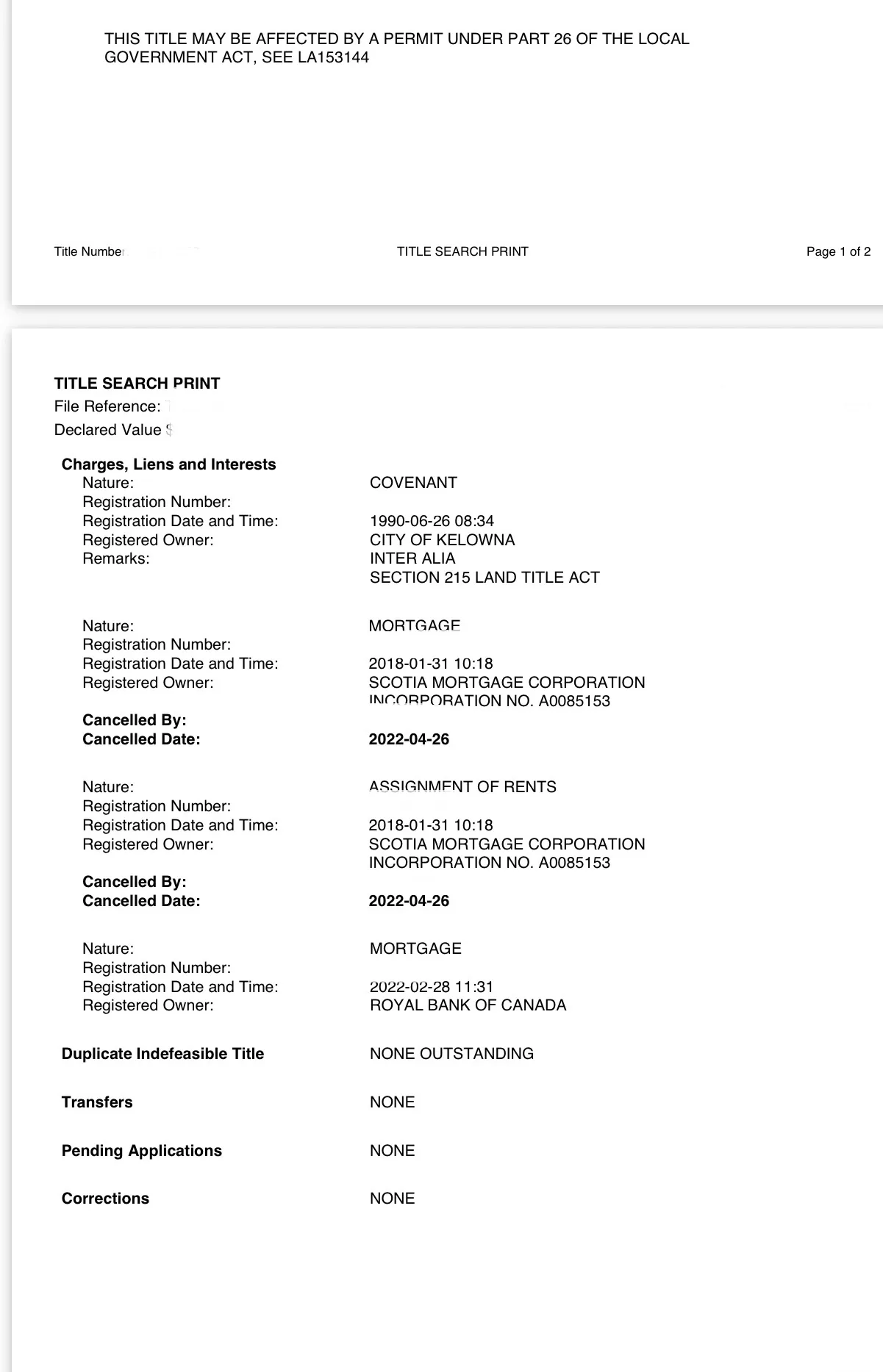
Here is what a covenant with an indemnity clause looks like on a BC title search:
Understanding “INTER ALIA” on a BC title search
You will frequently see the remark INTER ALIA next to a covenant, easement, or statutory right of way on a BC title search. This means the registered instrument is charged against more than one title — the property you are searching is one of several (sometimes many) parcels burdened by the same document.
A common reason for this: subdivision history. A covenant is often registered against a single parent parcel as a condition the local government imposed before approving subdivision. When that parent parcel is later subdivided into multiple lots, the charges do not disappear — each child lot inherits the same instrument. That is why a title search on any one of the resulting lots will show the covenant as INTER ALIA.
How covenants are registered — and what they look like on a BC title search
To bind future owners, a private restrictive covenant must meet the requirements of section 221 of the Land Title Act: the obligation must be negative or restrictive in the registrar’s opinion, and both the benefitted and burdened land must be satisfactorily described. Registration is not a guarantee of enforceability — section 221(2) expressly states that registering a covenant is not a determination of its essential nature or enforceability. An identical provision applies to statutory covenants under s. 219(10). The registrar also has authority to refuse registration if not satisfied that the obligation is negative or restrictive in substance, or if the descriptions of the burdened and benefitted land are insufficient. Because covenant terms bind future owners who had no part in drafting them, courts require that restrictions be stated with sufficient precision that a subsequent owner can know exactly what is imposed on the land.
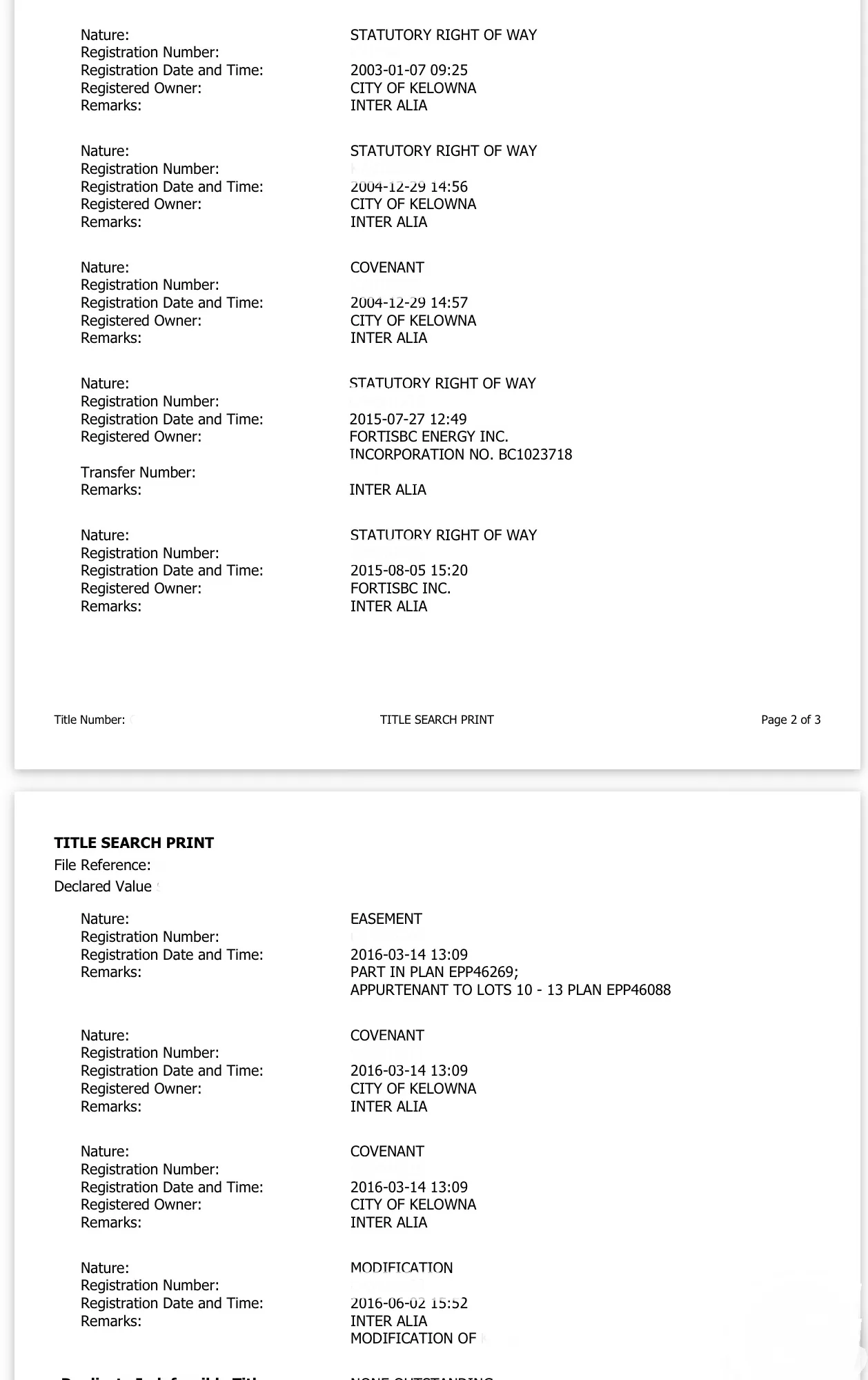
Covenants can also be modified after registration. A modification is registered as a separate instrument referencing the original covenant. Here is an example showing an easement, two covenants, and a modification all registered in connection with the same subdivision approval:
When can a covenant on title in BC be removed or changed?
A covenant does not expire automatically. Removing or modifying one requires either the consent of the party holding the benefit, or a court order under section 35 of the Property Law Act. The grounds for a court application are: the covenant has become obsolete; it impedes the reasonable use of the land without providing practical benefit to anyone; the parties entitled to the benefit consent to removal; or the proposed change will not injure those entitled to enforce it.
Courts apply this test strictly. Modern zoning changes alone rarely make a covenant obsolete — a covenant provides site-specific protection that zoning bylaws do not, and courts are reluctant to strip that protection without clear evidence the original purpose has been extinguished.
Covenants and property value
A registered covenant can meaningfully affect a property’s market value and what an owner is permitted to do with the land. BC Assessment must account for restrictive covenants that run with the land and cannot be discharged by the owner. A buyer who discovers a restrictive covenant after completing a purchase has limited remedies — which is why reviewing the full instrument, not just the title summary, is a standard part of due diligence in any BC real estate transaction.
One covenant BC law will not recognize
Section 222 of the Land Title Act voids any covenant that restricts the sale, ownership, occupation, or use of land based on a person’s sex, race, creed, colour, nationality, ancestry, or place of origin. These discriminatory covenants — some dating to the early twentieth century — are invalid and of no effect regardless of when they were created, as section 222 operates retroactively. The registrar may cancel a discriminatory covenant on their own initiative or on application by the owner, and there is no charge for making such an application.
Real-life example
Julian purchases a lot in a subdivision approved by the municipality in the late 1990s. The title search shows a covenant marked INTER ALIA in favour of the municipality. Julian’s BC Notary or lawyer pulls the full instrument and discovers it was registered against the original, larger parcel as a condition of the subdivision approval — restricting density and requiring a building setback from a nearby creek. Because the covenant was properly drafted to touch and concern the land and clearly identify the burdened parcels, it binds Julian as the current owner, even though he was never a party to the original agreement. His BC Notary or lawyer confirms the setback requirement before Julian finalizes his building plans.
Similar and related terms
Restrictive covenant — a negative covenant that prohibits a specific use of land; the most common type of private covenant registered on BC title.
Easement — a registered right allowing someone to use a portion of another person’s land for a specific purpose, such as a right of way. Unlike a covenant, an easement grants a positive right to another party rather than restricting the owner’s own conduct.
Charge on title — the umbrella term for any registered interest affecting a property, including mortgages, covenants, easements, and statutory rights of way.
Building scheme / Declaration of Building Scheme — a set of restrictive covenants registered under s. 220 of the Land Title Act by a developer to create uniform standards across a subdivision.
Frequently asked questions about covenants on title in BC
Not automatically. For a private covenant to bind a buyer who was not party to the original agreement, the instrument must meet specific legal requirements — it must be genuinely negative in substance, touch and concern the land, and clearly identify the burdened and benefitted parcels. Covenants registered under section 219 of the Land Title Act in favour of public bodies are an exception: the statute makes these binding on successors regardless. Always have the actual instrument reviewed, not just the title notation.
It means the registered charge — a covenant, easement, or right of way — is also registered against other titles, not just yours. It often arises when a parent parcel with an existing covenant was later subdivided, with all the resulting lots inheriting the same charge.
It is worth a closer look. Indemnity covenants are commonly attached to properties in floodplains, on steep slopes, or in other hazard-prone areas, where a government body has agreed to permit development on condition that the owner releases it from liability for future hazard-related damage. Ask your BC Notary or lawyer to review the full instrument and any underlying geotechnical or hazard assessment before completing your purchase.
No. BC does not impose automatic expiry on registered covenants. They remain in force until discharged with the consent of the party holding the benefit, or cancelled or modified by court order under s. 35 of the Property Law Act.
A zoning bylaw is a public law that applies to an entire zone and can be changed by a municipality. A covenant is a private or statutory agreement registered against a specific property. Even if zoning changes to permit a use, a covenant on your title may still prohibit it. The two operate independently and you must comply with both.
Not on the basis of protected characteristics. Section 222 of the Land Title Act voids any covenant that discriminates based on race, sex, creed, colour, nationality, ancestry, or place of origin, regardless of when it was registered.
Related Terms
- Charge on Title
- Restrictive Covenant
- Easement
- Building Scheme / Declaration of Building Scheme
Speak with a BC Notary about a covenant on your title
Covenants registered against a property’s title can significantly affect what you can build, how you can use the land, and what risks you may be inheriting along with it. Before you purchase, subdivide, develop, or renovate, it is worth knowing exactly what is registered — and what it actually means. The team at The Notary Group reviews title for BC real estate transactions every day. Contact us to speak with a BC Notary about your property.